How Long Should a Fireproof Safe Last?
Most home fireproof safes last 10 to 20 years, and the fire rating often fades before the steel fails. The lock, seal and fire-resistant filling decide when a safe needs replacing, so age alone isn't the whole story.
On this page (9 sections)
- What decides how long a fireproof safe lasts?
- How long do the fire ratings themselves last?
- Does a fireproof safe wear out?
- What shortens a fireproof safe's service life?
- How should you store a safe to get the longest life?
- Which fireproof safes are built to last?
- How often should you inspect and maintain a fireproof safe?
- How do you know when to replace a fireproof safe?
- Is a fireproof safe or a bag the better long-term buy?
A home fireproof safe usually lasts 10 to 20 years, and the fire rating often fades before the steel gives out. The filling, the door seal and the lock set the real service life, so a safe can look fine and still protect less than its label promises.
If you want to know how long should a fireproof safe last in your own home, start with where it sits and how it's built.
Shoppers ask this because a safe is a one-time buy meant to guard passports, deeds and backups. The answer depends on the type of safe, the room it lives in and whether the fire protection is UL Classified or a lighter claim.
What decides how long a fireproof safe lasts?
The fire-resistant filling and the door seal age first, and the lock ages second. Steel shells and bolt work can outlast both by years, so the rated protection is the part that wears out.
A UL Classified safe earns its rating through a tested build: a steel body packed with insulation and a door that seals against heat. That insulation is the part that degrades.
Moisture, repeated warmth and physical knocks break it down, and once it crumbles or soaks up water, the safe no longer holds interior temperatures the way it did when new.
The lock is simpler to judge. Digital keypads depend on batteries and electronics, while dial and key locks have fewer parts that fail.
A lock problem is usually fixable, but a fire barrier is not. That's why a safe's age matters less than its condition and storage spot.
Our guide to fireproof safe ratings explains how UL and ETL testing work.
How long do the fire ratings themselves last?
A fire rating describes a new safe in good condition, not a lifetime guarantee. The rated minutes and temperature tell you what the safe achieved in testing, not how it holds up after years in a damp basement.
SentrySafe rates its SFW123GDC and SFW123CU safes to UL Classified 1 hour at 1700°F. That means the safe kept interior conditions safe for documents during a one-hour test fire.
The same models carry ETL verification for a 15 ft fall during a fire and 24 hours of water protection up to 8 in deep. Those are strong claims, but they describe the product as built, not a promise that protection is identical a decade later.
Treat the rating as a starting point. A safe kept dry and cool will hold its protection longer than one in a humid garage.
If you buy secondhand, ask how and where it was stored before you trust the label.
Does a fireproof safe wear out?
Yes, though the wear is slow and mostly invisible. The safe won't stop being a locked steel box, but its ability to shield contents in a fire weakens as the fire-resistant material ages.
The most common failure is moisture. Insulation that takes on damp air can lose its ability to hold heat out, and the interior may rust along with it.
A safe in a garage or basement sees more temperature swings and higher humidity than one in a closet. A gasket that hardens or cracks lets heat and smoke reach the contents faster.
Digital locks also age as battery contacts corrode. None of this happens on a schedule, so condition beats years every time.
What shortens a fireproof safe's service life?
Damp rooms, hot spots and rough handling are the main life-shorteners. Each one attacks either the filling or the seal, and the damage usually shows up only when you need the safe most.
- Humid basements and garages: moisture is the top enemy of fire-resistant filling, and a concrete floor can pass damp upward.
- Direct heat and sunlight: a safe near a furnace or sunny window runs warmer than one in a stable room.
- Flood exposure: water protection has limits, and standing water around the base can reach the shell.
- Dropping or dragging: a fall can crack the filling even when the outside looks intact. The rated 15 ft fall protection is about staying shut in a fire, not surviving every drop.
- Forcing a stiff lock or door: prying a warped door can break the seal that makes the fire rating work.
How should you store a safe to get the longest life?
Put it in a dry, moderate room and keep the door closed. A stable spot with low humidity and mild temperatures is the single best way to make a fireproof safe last.
A closet or interior office beats a garage, attic or basement. If the safe must sit on concrete, lift it onto a board so damp doesn't wick into the base.
Keep it away from pipes and roof leaks. Bolt-down kits stop the safe tipping in a fall and deter removal.
The SFW123GDC includes a bolt-down kit and a pry-resistant hinge bar. SentrySafe recommends four name-brand alkaline AAA batteries with an expiration date 8–10 years out, and swapping them on that schedule keeps the keypad reliable.
Which fireproof safes are built to last?
A UL Classified steel safe with a waterproof seal and a simple lock gives you the longest useful life. The three SentrySafe models below cover a document box, a dial safe and a digital safe.
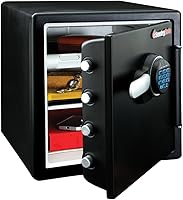
SentrySafe SFW123GDC
This is the safe we'd pick for most homes. It's UL Classified to 1 hour at 1700°F and ETL Verified for 24 hours of water protection up to 8 in deep, so it handles both fire and flood.
The 1.23 cu ft interior fits papers, USBs and DVDs, and the digital keypad has a backup key plus four live-locking bolts. The bolt-down kit and pry-resistant hinge bar make a permanent install easy.
SentrySafe SFW123CU Dial Safe
Pick this one if you'd rather skip batteries and electronics. The dial combination lock has no keypad to fail, and the fire and water ratings match the digital model: 1 hour at 1700°F and 24 hours in up to 8 in of water.
The same 1.23 cu ft interior and four live-locking bolts are there, along with floor or wall mounting options. A preset combination means no code to forget, though you can't change it.
SentrySafe HD4100 File Box
Choose this for paperwork alone. It's UL Classified for 30 minutes at high temperature and ETL Verified for water exposure, and the interior takes hanging file folders for passports, birth certificates and insurance records.
The key lock with two keys keeps the lid shut in a fire. At 0.65 cu ft it's compact and light enough to move, but it's a document box rather than a heavy bolted safe.
Our score weighs specs, features and buyer feedback against what you're shopping for. The SFW123GDC earns a 9, the HD4100 an 8.9 and the SFW123CU an 8.6.
The digital model's edge comes from its longer water rating and bolt-down setup; the dial model loses a little for its fixed combination. Our look at whether fireproof safes are worth it covers the trade-offs.
How often should you inspect and maintain a fireproof safe?
Check the safe once a year and after any move, flood or nearby fire. A short yearly routine catches the problems that quietly cut a safe's life short.
Open and close the door to feel for stiffness or a loose fit. Look at the gasket for cracks, and wipe the seal dry.
Check the shell for rust, especially at the base. Test the lock and swap the batteries if the keypad is digital.
Confirm the bolts still extend and retract smoothly. If the safe is bolted down, check the fasteners.
After a real fire or flood, don't trust the safe's protection again. Heat and water can damage the filling even when the outside looks sound.
Empty it, treat it as a storage box and buy a replacement.
How do you know when to replace a fireproof safe?
Replace it when the fire barrier or shell is damaged, not just when it's old. A worn lock or a dead keypad is a repair; a cracked seal or rusted-through body is a replacement.
Signs to replace:
- The door gasket is cracked, crumbling or missing.
- Rust has eaten through the shell or the door edge.
- The safe has been through a fire or a flood.
- The door no longer shuts flush or the bolts don't engage.
- The filling rattles or feels loose when you tap the door.
If only the lock is failing, a locksmith can often fix a dial or replace a keypad. That's cheaper than a new safe and keeps a sound body in service.
Compare options in our guide to whether fireproof safes work in a house fire before you spend on a replacement.
Is a fireproof safe or a bag the better long-term buy?
A safe lasts longer and protects more; a bag is cheaper and more portable. For a 10 to 20 year plan, a steel safe is the sturdier choice, while a bag suits renters and small document loads.
A safe holds its rated protection for years and secures against removal. A bag is light, easy to grab in an evacuation and costs far less, but it's a soft layer with a shorter working life.
Our comparison of a fireproof safe vs a fireproof bag helps you weigh the two.
For most homeowners, the answer to how long should a fireproof safe last is long enough to justify the spend, provided it's kept dry. Pick the SFW123GDC for documents, media and valuables in one place.
Pick the SFW123CU for a dial lock with no batteries. Pick the HD4100 if paperwork is all you need to protect.
Frequently asked questions
Does a fireproof safe lose its fire rating over time?
Yes, it can. The rated time and temperature apply to a safe in good condition.
Damp storage, repeated heat exposure and a worn door seal all reduce how well the filling protects paper, so a 10-year-old safe may not match its original rating.
Can I extend the life of a fireproof safe?
Keep it in a dry, moderate room, away from damp basements and hot garages. Check the seal and lock yearly, replace batteries on schedule and keep the door closed.
A dry, stable spot does more for service life than any accessory.
When should I replace a fireproof safe instead of keeping it?
Replace it when the door seal is cracked or the shell is rusted through. Also replace after the safe has been through a real fire or flood.
A lock that sticks or fails is often repairable, but a damaged fire barrier is not.