Are Fireproof Safes Really Fireproof?
Yes, a fireproof safe is really fireproof, but only within a stated time and temperature limit. Every honest rating pairs a duration with a temperature, so the useful question is which rating your documents actually need.
On this page (10 sections)
- What does "fireproof" actually mean on a safe label?
- Why a "fireproof" safe is never fireproof forever
- How do UL Classified and ETL Verified differ?
- Does a fireproof safe protect digital media?
- What rating do you actually need for your home?
- How do fireproof safes hold up in a real house fire?
- What are the common ways a fireproof safe fails?
- Fireproof safe or fireproof bag: which fits your papers?
- Which fireproof safes carry a rating you can trust?
- The short answer on fireproof safes
Yes, a fireproof safe is really fireproof, but the word is short for a specific promise. Every honest rating pairs a time with a temperature, such as 1 hour at 1700°F.
The question is whether its rating covers the kind of fire your home could have.
That distinction matters because the marketing word and the tested number are not the same thing. A box can say "fireproof" on the front and carry a 30-minute label inside.
Reading the label tells you what you are actually buying.
What does "fireproof" actually mean on a safe label?
Fireproof means the safe kept its interior below a set limit for a set time during a controlled burn. An independent lab heats the safe in a furnace and watches the inside.
If paper inside stays under roughly 350°F for the full window, the safe earns the rating printed on its label.
That is why the label always shows two numbers. The temperature describes the furnace the safe survived.
The time describes how long the test ran.
The common UL ratings you will see are 30 minutes at 1550°F and 1 hour at 1700°F. A safe built to the second one holds its interior cool about twice as long in a hotter fire.
It also costs more and usually weighs more.
The rating assumes the door stays shut and the safe stays in place. A safe that falls through a burning floor or gets dragged outside its rated conditions is no longer covered by the label.
Why a "fireproof" safe is never fireproof forever
No safe survives every fire. A rating is a window, not a guarantee.
Heat keeps building after the test ends, and a fire that burns past the rated time will eventually push the interior past the limit.
Think about the difference between a kitchen fire and a house fire. A kitchen fire is usually spotted and put out in minutes.
A house fire in a rural area can burn far longer before a crew arrives.
The safe's rating is the number you buy against that risk. If your nearest fire station is 20 minutes away, a 30-minute box leaves you very little margin.
A 1-hour safe gives you room to be wrong about how fast help arrives.
Steel alone conducts heat quickly. Fire-rated safes add insulation between the steel shell and the interior so the contents warm slowly instead of instantly.
How do UL Classified and ETL Verified differ?
UL Classified is a fire test. ETL Verified usually covers other properties, such as water resistance or surviving a fall.
The two labels answer different questions, and a safe can carry one without the other.
A UL Classified label tells you the safe passed a published fire standard for a stated time and temperature. That is the line to look for first, because fire is the threat most people buy a safe to beat.
An ETL Verified line often describes water. A safe marked for 24 hours in water up to 8 inches deep has been checked for that, which matters when a fire crew hoses a burning room.
Some safes also carry a fall rating, telling you the door won't pop open when the floor gives way. That is a separate check from the fire rating.
Read both labels when you can. Fire protection and water protection are separate promises, and you want the safe to carry the ones that match your home.
Does a fireproof safe protect digital media?
Only if the label says so. Paper tolerates more heat than DVDs and USB drives do.
A safe rated for paper may still run hot enough inside to damage electronics.
Paper needs to stay below about 350°F. Media tolerates less heat for less time, so a media-rated safe holds a tighter interior limit for a shorter window.
If your valuables are passports, birth certificates and insurance papers, a paper rating is the right target. If you also store family photos on drives or discs, look for a safe with a media rating, or keep the drives in a separate media-rated container.
Don't assume a bigger safe is a cooler one. Capacity and fire rating are separate specs, and a large box with a short rating offers no more protection than its label promises.
What rating do you actually need for your home?
Match the rating to your fire risk, not to the price tag. A 30-minute safe suits most apartments and homes close to a staffed station.
A 1-hour safe suits rural homes, detached garages and anyone who wants more margin.
Start with response time. Call your fire department's non-emergency line and ask how long a typical response takes in your area.
That single number decides more than any marketing claim.
Then think about where the safe sits. A safe in a closet or interior room faces less direct flame than one in a garage or shed.
A garage safe needs the longer rating because a car fire can burn hot and long.
Finally, decide what goes inside. Paper only?
A 30-minute rating is reasonable. Paper plus drives?
Look for a media rating on top of the time. Anything irreplaceable deserves the longer window.
If you are still weighing whether the spend makes sense at all, our guide to whether fireproof safes are worth it walks through the cases where they clearly pay off.
How do fireproof safes hold up in a real house fire?
A rated safe does its job when the fire stays inside the rating and the door stays closed. In a real house fire, the safe faces heat from every side, falling debris and water from hoses.
The label covers the first two only partly.
The furnace test is brutal, but it is still a test. It runs at a steady temperature for a set time.
A real fire rises and falls, and the safe may sit in hot embers well after the flames die down.
Water is the other half. Fire crews spray thousands of gallons into a burning room, and a safe without a water rating can let that in through the door seam.
A safe with an ETL water line is built to keep it out.
The honest summary is that a rated safe gives you a tested window of protection. It does not make documents indestructible.
It buys you time for the fire to be found and put out before the interior gets too hot.
Our guide to whether fireproof safes work in a house fire covers what the tests do and don't capture in more detail.
What are the common ways a fireproof safe fails?
Most failures come from the fire outlasting the rating, the door being open, or water getting in. Each one is avoidable once you know it is a risk.
The first is time. A 30-minute safe in a fire that burns for an hour will fail, and no label can prevent that.
Buy the longer rating when your area's response time is uncertain.
The second is an open or ajar door. A safe only protects its contents when the door is latched.
A box left open during a panic is just a metal container.
The third is water. A fire-rated safe without a water rating can fill with hose spray.
If floods or burst pipes are a concern in your area, look for the water line too.
The fourth is placement. A safe on a weak floor can fall through and land in the fire below.
Bolting it down, as several models allow, keeps it where the rating was tested.
Fireproof safe or fireproof bag: which fits your papers?
A fireproof safe suits documents you also want locked up. A fireproof bag suits papers you need to grab and carry.
The bag is lighter and cheaper, but it protects less and usually carries a shorter rating.
A bag works well for a folder of passports and birth certificates in a rental where you can't bolt anything down. It also packs into a go bag if you might evacuate.
A safe adds security on top of fire protection. A locked door and a bolted base stop a thief as well as a fire.
If your papers are both valuable and irreplaceable, the safe covers more ground.
Our comparison of a fireproof safe vs a fireproof bag lays out the trade-offs side by side.
Which fireproof safes carry a rating you can trust?
Pick a safe with a printed UL or ETL label and a time that matches your fire risk. These three carry ratings, and each one suits a different household.
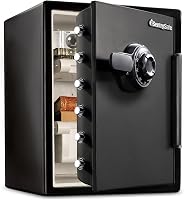
The SentrySafe SFW123GDC is the pick for most homes. It carries a 1-hour fire rating, water protection for 24 hours up to 8 inches deep, and a digital keypad with a backup key.
Its 1.23 cu ft interior fits files and a small lockbox of valuables. Our score is 9.
The SentrySafe HD4100 File Box suits paperwork you want organized and portable. It is rated for 30 minutes and checked for water exposure, and its interior takes hanging folders.
That makes it a good fit for a home office or a closet shelf. Our score is 8.9.
The Pockrif Small 35 Minute Fire Safe is the compact option. It holds 0.5 cu ft and is rated for 35 minutes at 1800°F, with a keypad and backup keys.
It suits a nightstand, a drawer or a small apartment where space is tight. Our score is 7.4.
For a wider look at the top-rated models across categories, see what the highest rated fireproof safe is before you decide.
The short answer on fireproof safes
A fireproof safe is really fireproof within its label, and the label is the only part you can hold anyone to. Buy for your response time, your contents and your placement.
A 1-hour rated safe for a rural home, a 30-minute box for a city apartment, and a media rating if drives go inside.
Pick the SentrySafe SFW123GDC when you want the longest window and water protection together. Choose the HD4100 when file organization and portability matter more than time.
Take the Pockrif when space is the limit. Whichever you choose, check that "is a fireproof safe really fireproof" gets answered by a printed time and temperature, not by the word on the box.
Frequently asked questions
Is a fireproof safe really fireproof?
Yes, within a stated limit. A safe rated for 1 hour at 1700°F is built to keep its interior cool enough for paper for that long in that heat.
Nothing is fireproof forever, so the rating is the real promise.
What does UL Classified mean on a fireproof safe?
UL Classified means an independent lab tested the safe to a published fire standard. The label names the time and temperature it survived, so you can compare it against the fire risk in your home rather than trusting a marketing word.
Is a 30-minute fire rating enough?
It often is for a quick room fire that firefighters reach fast. It is thin protection for a house fire in a rural area or a detached garage, where the fire can burn longer before help arrives.
Pick a 1-hour rating when the response time is long.
Can a fireproof safe fail in a real fire?
It can if the fire outlasts the rating, if the safe falls through a floor, or if the door is left open. A rated safe is tested for a set window and a closed door.
Buy for the worst fire your area is likely to produce, not the average one.
Does a fireproof safe keep documents safe from water?
Only if it carries a water rating. Fire hoses and burst pipes are a separate test, so look for an ETL water-resistance line on the label.
A fire rating alone tells you nothing about water.